TL;DR
- How to file an external review of an insurance denial in Ohio.
- State laws often provide additional protections beyond federal minimums, including longer appeal deadlines, broader coverage mandates, and stronger consumer rights.
- Your Ohio Department of Insurance can help you file complaints, navigate the appeals process, and access free consumer assistance programs.
- External review processes vary by state, but all states must meet federal minimum standards under the Affordable Care Act.
- DenialCrusher generates state-specific appeal letters that cite Ohio laws and regulations at /start.
Ohio External Review Process
There is more to ohio External Review Process than general advice suggests. How to file an external review of an insurance denial in Ohio.
External review is one of the most powerful tools available to patients in Ohio. The independent reviewer evaluates your case based exclusively on the clinical evidence, your plan's terms, and applicable medical standards, without the financial pressures or institutional biases that may influence your insurer's internal review process.
Data from state insurance departments across the country consistently shows that external reviews overturn insurer decisions in a significant percentage of cases, typically in the range of 40% to 70%. This high reversal rate is strong evidence that many insurance company denials do not withstand independent, unbiased clinical scrutiny.
The Ohio Department of Insurance oversees the external review process for state-regulated plans (individual and small group market plans). Self-funded employer plans are subject to the federal external review process under the Affordable Care Act. Understanding which process applies to your plan helps you file correctly and avoid procedural delays.
This guide covers the eligibility requirements, filing procedures, timelines, and strategic tips for the Ohio external review process.
Key Consumer Protections in Ohio
| Protection | What It Provides | Who It Applies To | How to Use It |
|---|---|---|---|
| Internal appeal rights | Right to have your denied claim reviewed by a different reviewer at your insurer | All health plans in Ohio | File within the deadline stated in your denial letter |
| External review | Independent review by a certified external reviewer at no cost to you | State-regulated plans | Request after exhausting internal appeals |
| Expedited review | Faster review process for urgent or life-threatening medical situations | All health plans | Request immediately, indicating urgency, with supporting medical documentation |
| Continuation of benefits | Right to continue receiving treatment during the appeal process | Varies by plan type and situation | Request within the required timeframe after denial |
| Prompt payment | Deadlines for insurers to process and pay clean claims | State-regulated plans | File complaint if payment is delayed beyond the deadline |
| Network adequacy | Requirements for insurers to maintain adequate provider networks | State-regulated plans | Argue for out-of-network coverage when no adequate in-network provider exists |
| Surprise billing protections | Protection from unexpected out-of-network charges at in-network facilities | Varies by state law, supplemented by federal No Surprises Act | Dispute any surprise balance bills |
| Consumer assistance | Free help from state programs for insurance disputes | All Ohio residents | Contact your state's Consumer Assistance Program |
These protections work together to create a comprehensive safety net for patients dealing with insurance denials in Ohio. When you reference specific state laws in your appeal letter, it signals to the insurer that you understand your rights, know the regulatory framework, and are prepared to use all available remedies if the denial is not properly reconsidered.
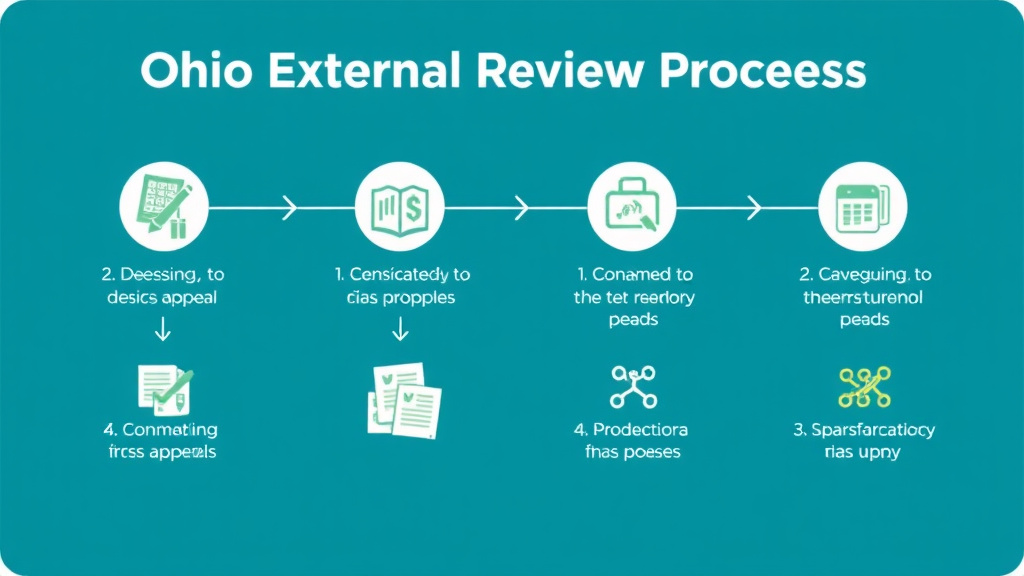
How to File an Appeal in Ohio
Step 1: Read the denial letter carefully. Identify the exact reason for the denial, the plan provision or clinical criteria cited, and the appeal deadline. Most plans give you 180 days for an internal appeal, but some have shorter deadlines. Never assume you know the deadline without checking. Mark it on your calendar immediately.
Step 2: Request your complete claim file. Under federal law (ERISA for employer plans, ACA for marketplace and individual plans), you have the right to receive every document your insurer used to make its decision. This includes clinical review criteria, medical director notes, internal communications, and any guidelines applied to your case. Reviewing these documents helps you understand exactly what the insurer considered and where their reasoning may be weak.
Step 3: Gather supporting evidence. This is where your appeal gains real strength. Work with your treating physician to compile relevant medical records, clinical notes, test results, imaging studies, and pathology reports. Ask your doctor to write a detailed letter of medical necessity explaining why the denied service is essential for your health and why alternatives are not appropriate for your specific situation.
Step 4: Research clinical guidelines and medical literature. Search PubMed (pubmed.ncbi.nlm.nih.gov) for peer-reviewed studies supporting the denied treatment. Look for clinical practice guidelines from organizations like the American Medical Association, specialty medical societies, and the National Comprehensive Cancer Network. These authoritative sources carry significant weight with insurance reviewers and independent review organizations.
Step 5: Write your appeal letter. Your letter should be clear, factual, and directly address the specific reason for the denial. Reference the denial code, cite specific plan language, include clinical guidelines that support your case, reference applicable laws, and attach all supporting documentation. This is where DenialCrusher can help. Our AI generates medically specific, legally formatted appeal letters that address the exact reason for your denial.
Step 6: Submit your appeal with proof of delivery. Send your appeal by certified mail with return receipt or through your insurer's online portal. Keep copies of everything. If submitting online, screenshot the confirmation page. Note the date you submitted and calculate when the insurer's response is due (typically 30 days for pre-service, 60 days for post-service).
Step 7: Follow up proactively. Call your insurer one week after submission to confirm receipt. If you do not receive a decision within the required timeframe, contact your insurer immediately. Failure to respond within the required timeframe may constitute a procedural violation that strengthens your case and may allow you to proceed directly to external review.
In Ohio, you may have additional options beyond the standard federal process. Check with the Ohio Department of Insurance for state-specific appeal procedures, forms, and deadlines that may apply to your plan type.
Ohio Department of Insurance Resources
Your state department of insurance is one of the most valuable resources available to you throughout the appeals process. Here is how they can help at every stage.
Consumer assistance programs. Many state departments of insurance, including Ohio's, offer dedicated consumer assistance programs that can help you understand your rights, navigate the appeals process, review your denial letter, and even advocate on your behalf with the insurer. These services are provided free of charge and are staffed by professionals who understand insurance law and the appeals process.
Complaint investigation. When you file a formal complaint with the Ohio Department of Insurance, it triggers a review process. The department contacts the insurer, requests a response, and evaluates whether the insurer followed proper procedures and complied with state law. This investigation creates accountability and can put significant pressure on the insurer to resolve your case fairly.
External review administration. In Ohio, the department of insurance administers or oversees the external review process for state-regulated plans. They ensure that Independent Review Organizations (IROs) are properly certified, that cases are assigned to qualified reviewers, and that reviews are conducted within required timeframes.
Market conduct oversight. State regulators continuously monitor insurance company practices through market conduct examinations and complaint trend analysis. When an insurer shows patterns of improper denials, inadequate network access, or procedural violations, the department can take enforcement action that benefits all consumers. Your individual complaint contributes to this oversight and can help protect other patients from similar treatment.
Educational resources. The Ohio Department of Insurance publishes guides, fact sheets, and online resources that explain your rights, outline the appeals process, and provide templates and contact information. These resources are available on their website and are updated regularly.
You do not need to wait until you have exhausted internal appeals to contact your state department of insurance. They can provide guidance at any stage, and early contact can help you avoid procedural mistakes that could weaken or delay your appeal.
Related: California External Review Process for Insurance Denials
See also: How to Track Your Insurance Appeal
Appeal Success Statistics
Understanding the data behind insurance denials and appeals helps you see why fighting back is worth the effort.
| Statistic | Data Point | What It Means for You |
|---|---|---|
| Annual claim denials | Approximately 73 million per year in the United States | You are not alone. Denials are a systemic issue, not a reflection of your claim's merit. |
| Appeal rate | Less than 1% of denied claims are appealed | Most patients give up. Those who fight have a significant advantage. |
| Internal appeal success | Roughly 40-60% of internal appeals result in the denial being overturned | Your odds of winning are better than a coin flip when you submit strong evidence. |
| External review success | 40-70% of external reviews overturn the insurer's decision | Independent reviewers frequently disagree with insurance company denials. |
| Average claim value | Denied claims range from hundreds to hundreds of thousands of dollars | The financial stakes are almost always worth the effort of an appeal. |
| Time to appeal | Most patients spend 2-5 hours preparing an appeal | A few hours of work can save thousands of dollars. DenialCrusher reduces this to minutes. |
These numbers hold true in Ohio as they do nationally. The patients who fight back are the patients who win. Every denial you accept without appealing is money left on the table and care left unreceived.
Generate Your Appeal Letter Now
Fighting your insurance denial in Ohio takes time and effort, but you do not have to do it alone. DenialCrusher generates medically specific, legally formatted appeal letters tailored to your exact situation, your insurer, and the specific reason for your denial.
Our AI analyzes your denial details and creates a comprehensive appeal letter that cites relevant clinical guidelines, references applicable federal and state laws, and presents your case in the format that insurance reviewers and external review organizations expect to see. You get the same quality of letter that professional patient advocates and insurance attorneys produce, at a fraction of the cost and in a fraction of the time.
A single appeal letter is $29. A 3-pack is $79 for patients dealing with multiple denials or who want letters for different levels of appeal (internal appeal, second-level appeal, and external review preparation).
Generate My Appeal and take the first step toward overturning your denial today.
Try our free tools
Frequently Asked Questions
How does the external review process work in Ohio?
When your internal appeal with your insurance company has been denied in Ohio, you have the right to request an external review. This is an independent evaluation of your case by a certified reviewer who has no connection to your insurer, no financial interest in the outcome, and no bias toward upholding the original denial.
What key consumer protections are available in Ohio for insurance denials?
Ohio has several important consumer protections that work together to create a comprehensive safety net for patients dealing with insurance denials. These include the right to an internal appeal, the right to an independent external review, and the ability to request an expedited review in urgent situations. By referencing these specific state laws in your appeal, you signal to the insurer that you are informed and prepared to fight the denial.
How to File an Appeal in Ohio?
Fighting your insurance denial in Ohio takes time and effort, but you do not have to do it alone. Services like DenialCrusher can generate medically specific, legally formatted appeal letters tailored to your exact situation, your insurer, and the specific reason for your denial. These letters cite relevant clinical guidelines, reference applicable laws, and present a compelling case for why the denied service or treatment should be covered.
How can the Ohio Department of Insurance help with my appeal?
Your state department of insurance is one of the most valuable resources available to you throughout the appeals process in Ohio. They can provide guidance on your rights, help you understand the appeals process, and even intervene on your behalf if necessary. The department can also assist with filing complaints and escalating your case if the insurer is not following the proper procedures.
What do the statistics say about insurance denials and appeals?
Understanding the data behind insurance denials and appeals helps you see why fighting back is worth the effort. Approximately 73 million claims are denied each year in the United States, but less than 1% of denied claims are actually appealed. This means that most patients give up, even though the odds of success are often quite good. By appealing your denial, you are taking an important step to stand up for your rights and access the care you need.
How can DenialCrusher help with my insurance denial in Ohio?
Fighting your insurance denial in Ohio takes time and effort, but you do not have to do it alone. DenialCrusher generates medically specific, legally formatted appeal letters tailored to your exact situation, your insurer, and the specific reason for your denial. Their AI analyzes your denial details and creates a comprehensive appeal letter that cites relevant clinical guidelines, references applicable laws, and presents a compelling case for why the denied service or treatment should be covered.